
The Government has now given commercial landlords a clearer direction of travel on Minimum Energy Efficiency Standards, usually known as MEES. The proposed requirement is no longer an interim EPC C milestone in 2027. Instead, the focus has shifted to a proposed EPC B standard from 2031 for larger privately rented non-domestic buildings over 1,000 square metres, where cost-effective.
That may sound like a long runway. In practice, it is not. For commercial property owners, asset managers, facilities teams and public-facing landlords, improving a building from EPC E, D or C to EPC B is rarely a single works package. It can involve building surveys, EPC modelling, M&E upgrades, lighting replacement, controls, fabric improvements, lease discussions, access planning and phased delivery around occupied buildings.
The important point is this: the 2027 milestone has been removed, but the commercial property retrofit challenge has not. Landlords now have more time to plan, but also less excuse to leave EPC strategy until the last minute.
On 18 June 2026, the Government published an interim response on strengthening non-domestic MEES in England and Wales. The key proposal is that, from 2031, privately rented non-domestic buildings over 1,000 square metres will be required to meet EPC B, where cost-effective. Buildings below that threshold are expected to remain subject to the existing EPC E requirement.
This is a significant change in emphasis. Previous consultations explored a future trajectory involving EPC C by 2027 and EPC B by 2030. The interim response confirms that the 2027 EPC C milestone will not be taken forward. Instead, the Government is moving towards a more targeted approach for larger buildings, with further legislation and guidance expected.
For landlords, the removal of the 2027 milestone should not be read as a reason to stop planning. It should be read as an opportunity to plan properly. Larger commercial buildings often need multiple interventions to improve energy performance, and those interventions are easier to deliver when they are aligned with lease events, planned maintenance, plant replacement and refurbishment cycles.
Commercial retrofit is most expensive when it is reactive. The earlier a landlord understands the gap between the current EPC rating and the likely future standard, the more options they have for cost-effective improvement.
The proposed 2031 standard is aimed at larger privately rented non-domestic buildings over 1,000 square metres. That makes it particularly relevant to commercial landlords, institutional investors, multi-site property owners and asset managers responsible for larger buildings or mixed portfolios.
Office buildings are likely to be a major area of focus because energy performance is now tied to occupier expectations, corporate ESG reporting and marketability. Even before legal minimum standards rise, poor energy performance can affect letting prospects, tenant negotiations and future capital value.
For offices, EPC improvement often involves lighting, controls, heating, cooling, ventilation, fabric performance and smarter operation. The biggest challenge is usually not identifying improvements. It is coordinating them around occupation, lease obligations, dilapidations, service charge recovery and future refurbishment plans.
Larger retail, leisure and industrial buildings can have very different energy profiles. A warehouse with basic lighting and heating is not the same as a leisure facility with high ventilation and hot water demand, or a retail unit with intensive lighting, cooling and operational hours.
That is why generic EPC advice is rarely enough. Landlords need to understand the building fabric, the actual plant, the tenant’s use, metering arrangements and the practical route to improvement. A cost-effective upgrade for one asset may be entirely unsuitable for another.
Many larger commercial buildings are effectively public spaces: shopping centres, civic buildings, healthcare-adjacent facilities, education support buildings, offices with public access and mixed-use community assets. In these settings, retrofit planning is not just about the specification. It is about maintaining access, safety, continuity and user experience during the works.
The landlords who start early will have more opportunity to phase works around occupation, planned maintenance and capital budgets rather than forcing disruptive upgrades into a narrow compliance window.
The main timeline shift is simple: the expected 2027 EPC C milestone for non-domestic MEES is no longer being taken forward. The proposed future requirement is now focused on EPC B from 2031 for larger privately rented non-domestic buildings over 1,000 square metres, where cost-effective.
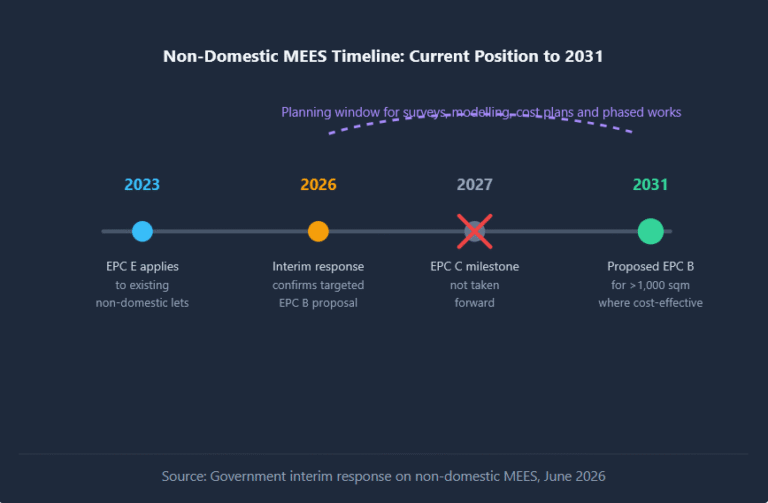
This timeline creates a practical planning window. Landlords now have time to review existing EPCs, test upgrade options, align works with planned maintenance and avoid treating compliance as a last-minute capital shock.
The risk is that a long deadline encourages delay. In commercial buildings, five years can disappear quickly once survey work, design, tenant engagement, approvals, procurement and phased delivery are taken into account.
The better response is to start with information. Landlords should establish current EPC status, understand whether a property is likely to fall within the proposed threshold, and assess whether existing maintenance or refurbishment plans can be shaped around future energy performance requirements.
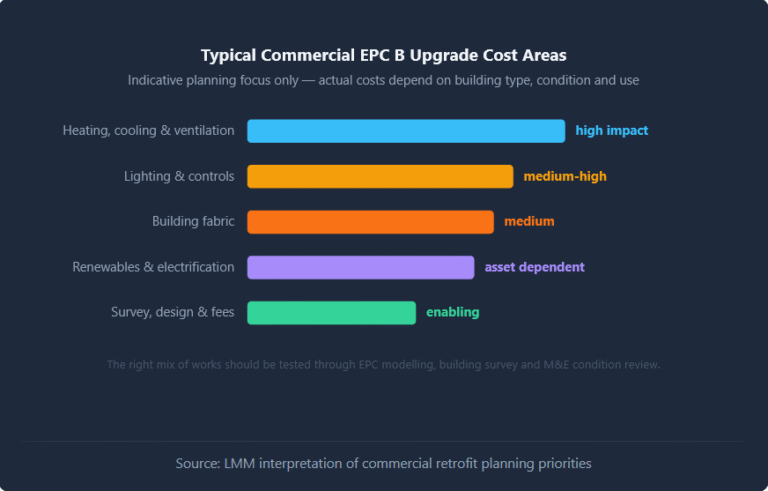
Commercial EPC improvement is not normally driven by one item. A landlord may improve lighting but still be held back by inefficient heating. They may replace plant but still have weak controls. They may upgrade insulation but fail to achieve the expected EPC movement because the building’s operational model, ventilation or hot water demand has not been understood properly.
The highest-value first step is not always the most expensive intervention. In some buildings, lighting and controls may produce fast gains. In others, the key issue may be heating, cooling and ventilation. For older assets, fabric condition and air leakage may need to be understood before major plant decisions are made.
This is why landlords should avoid treating EPC recommendations as a complete capital strategy. EPC reports are important, but they should be tested against condition data, occupancy, lifecycle replacement, lease arrangements and the landlord’s wider asset plan.
The proposed threshold matters because it concentrates the higher future standard on larger non-domestic rented buildings. For landlords with larger assets, the question is not just whether a building has an EPC. It is whether the property sits within the proposed scope, what its current rating is, and what investment would be required to reach EPC B where cost-effective.
Portfolio landlords should start by mapping their assets into categories:
This turns a broad compliance question into a practical asset management exercise.
For mixed portfolios, this may reveal different strategies. A large office with a weak EPC and ageing plant may need a full retrofit roadmap. A smaller unit may remain subject to the existing EPC E standard. A building due for major refurbishment may offer an opportunity to integrate energy upgrades into works already planned.
The danger is treating 2031 as a single future deadline rather than a series of decisions that need to happen between now and then. Survey, modelling, design, cost planning, tenant engagement and procurement all need their own lead-in time.
MEES compliance is often discussed as a landlord problem, but the practical reality is more complex. Commercial buildings are occupied, altered, fitted out, sub-metered, repaired and managed through lease structures. The way a tenant uses a building can affect energy demand, while the landlord may control core systems, fabric, common areas and major plant.
This creates a coordination issue. If a landlord needs to upgrade heating, cooling, lighting or fabric, those works may require access to occupied areas. They may intersect with tenant fit-out, service charge provisions, dilapidations, rent reviews or lease renewals. Without early planning, EPC improvement becomes more disruptive and more commercially sensitive.
Asset managers also need to think beyond compliance. A building that struggles to reach future standards may become harder to let, harder to finance and harder to sell. Conversely, a building with a clear improvement plan may retain more value because the risk is understood and budgeted.
The central commercial point is simple: energy performance is becoming part of asset quality. It should sit alongside condition, compliance, location, lease profile and income security when landlords assess long-term value.
A good MEES 2031 plan should start with evidence, not assumptions. Landlords need to know where each asset stands today before they decide what to spend.
The practical starting point is a portfolio review. Identify current EPC ratings, expiry dates, floor areas, lease events, known condition issues, planned works and buildings likely to fall within the proposed 1,000 square metre threshold. This gives landlords a first view of where the greatest risk sits.
The next step is technical assessment. An EPC review should be supported by building surveys, M&E condition assessment, fabric review and cost planning. The aim is to separate quick wins from deeper capital works, and to understand which interventions genuinely move the building towards EPC B.
From there, landlords can create a phased plan. That might include LED lighting and controls in year one, plant replacement aligned to lifecycle in year two, fabric upgrades at lease break, or larger refurbishment when a tenant vacates. The point is to integrate MEES into existing property decisions rather than treating it as a detached compliance cost.
For larger estates, ranking is essential. Not every building needs the same response at the same time. The highest priority should go to buildings above the threshold, below EPC B, with near-term lease events, known plant risk, poor condition, significant energy demand or future letting exposure.
There is a reasonable reason to wait before making irreversible compliance assumptions: further legislation and supporting guidance are still expected. Details may change, including aspects of implementation, evidence, enforcement and exemptions.
But waiting for final legislation is not the same as doing nothing. Landlords can still take sensible preparatory steps now. They can review EPC data, inspect assets, update condition information, model likely improvement pathways and align future works with building lifecycle plans.
That distinction matters. A landlord does not need to commit to every future capital item today. But they should understand the likely scale of exposure and the buildings most likely to need action.
In practice, the landlords best placed for 2031 will be those that use the next few years to make measured, evidence-led decisions. The weakest position will be held by landlords who wait until the rules are final, discover that several assets are below the expected standard, and then try to procure retrofit works under deadline pressure.
LMM’s building consultancy team works with property developers, public sector estates managers and multi-academy trusts across Manchester, Liverpool and London. If you’re planning a project in 2026 and need expert cost, programme and delivery guidance, speak to a consultant today.
The Government has proposed that, from 2031, privately rented non-domestic buildings over 1,000 square metres in England and Wales will need to meet EPC B, where cost-effective. Buildings below 1,000 square metres are expected to remain subject to the existing EPC E minimum standard.
No. The Government’s June 2026 interim response states that the previously consulted interim EPC C milestone for 2027 will not be taken forward. That gives landlords and tenants more time to plan investment and retrofit works around building use and lease structures.
The proposed higher standard is aimed at privately rented non-domestic buildings over 1,000 square metres. This may include larger offices, retail premises, leisure facilities, industrial buildings, mixed-use commercial assets and other qualifying non-domestic rented buildings in England and Wales.
Commercial retrofit works often require survey, EPC modelling, landlord and tenant coordination, design, cost planning, procurement and phased delivery. Waiting until the deadline is closer can increase disruption and reduce the landlord’s ability to make cost-effective decisions.
A good plan should include an up-to-date EPC review, building condition survey, M&E assessment, fabric review, lease and occupation constraints, cost plan, lifecycle replacement strategy, procurement route and programme for phased delivery.
MEES 2031 gives larger commercial landlords a clearer direction of travel. The immediate 2027 EPC C milestone has been removed, but the proposed EPC B requirement for larger privately rented non-domestic buildings means energy performance remains a long-term asset issue.
The landlords who benefit from the extended runway will be the ones who use it properly. That means reviewing EPC data, inspecting buildings, understanding M&E condition, testing improvement options and aligning retrofit works with lease events, maintenance plans and capital budgets.
Waiting may feel safe while the legislation is still developing, but doing nothing creates its own risk. By the time final rules arrive, the most cost-effective opportunities may already have passed: plant may have been replaced without regard to EPC impact, refurbishments may have missed fabric upgrades, and lease events may have closed without securing access for future works.
For commercial landlords, MEES 2031 should be treated as a portfolio planning issue now. The goal is not simply to comply with a future rule. It is to protect asset value, reduce operational risk and make buildings more resilient, lettable and fit for the next decade.