
The School-Based Nursery Capital Grant 2027 to 2030 creates a clear opportunity for local authorities, schools and early years providers to secure investment in facilities that enhance learning environments and increase the availability of nursery places. However, it also creates a practical estate challenge, that being identifying which school sites can genuinely support new or expanded nursery provisions without creating avoidable cost, safeguarding, access or compliance problems later.
The Department for Education has confirmed that phase 3 of the programme will invites local authorities to develop multi-year proposals for new and extended school-based nurseries between 2027 and 2030. This funding can support provisions in state-funded primary-phase schools, maintained nursery schools and Best Start Family Hub sites.
For schools, the deadline may look like a funding issue, however in reality it is also a building issue. Before a local authority puts a project forward, it needs confidence that the proposed space is suitable, affordable, deliverable and aligned with the wider school estate strategy. This article explains the estate questions that should be answered before proposals are submitted.
The School-Based Nursery Capital Grant 2027 to 2030 is the third phase of the government’s school-based nursery programme. Its purpose is to help more families access early years provisions, including families in disadvantaged areas.
Unlike earlier phases, phase 3 is built around local authority-led multi-year proposals. Local authorities are invited to put forward plans to create or expand school-based nursery provisions across the 2027 to 2030 period. The programme can support projects in state-funded primary-phase schools, maintained nursery schools and Best Start Family Hub sites.
This makes the role of the local authority central. Schools may identify demand, available accommodation and/or a strategic opportunity, but they cannot simply submit their own phase 3 application. They need to engage with their local authority, demonstrate local need and show that the proposed estate solution is credible.
For local authorities, the practical task is to decide which possible projects should be developed into a proposal. That means comparing demand, deprivation, local childcare sufficiency, value for money, deliverability as well as the suitability of the buildings themselves.
A school-based nursery is not created by relabelling a spare room, it changes how the site works. It can affect arrival routes, security, toilets, safeguarding, outdoor space, catering, staff accommodation, storage, energy use, heating, ventilation and the wider use of the entire school estate.
A classroom may appear available, but that does not mean it is suitable for nursery use. The DfE’s establishing provision guidance points schools toward questions of surplus space, outdoor space, SEND suitability, EYFS requirements and long-term financial sustainability. Condition and value for money are also specifically identified as part of the suitability assessment.
That matters because many schools are already balancing competing priorities: falling or rising rolls, inclusion bases, wraparound care, breakfast clubs, SEND support, community use and/or future curriculum needs. A nursery proposal has to fit in with the estate strategy rather than undermine it.
Early years provisions create a different traffic and safeguarding demand from the main school day. Parents and carers may need drop-off and collection access at different times, children may arrive with buggies, scooters or be dropped off with older siblings. Secure routes, controlled access, waiting space, lighting and separation from vehicles all become part of the estate case.
The DfE guidance also recommends direct level access to a dedicated enclosed outdoor play area where possible. That immediately narrows the number of spaces that may be appropriate without significant adaptation.
Heating, ventilation, hot water, drainage, toilets, food preparation, lighting, security systems and access controls all need to be reviewed before a project is put forward. A nursery may require low-level sinks, child toilets, nappy changing facilities, storage, quiet rooms, catering arrangements and a more intensive daily cleaning schedule.
If these requirements are not assessed early, a project that looks affordable as a light refurbishment can become a more complex building services, drainage, safeguarding and compliance project later.
Although the headline deadline is 5pm on 30 September 2026, the practical estate deadline is considerably earlier. Local authorities need enough time to identify the candidate sites, assess their suitability, prepare the project plans, evaluate value for money and submit proposals through the online service.
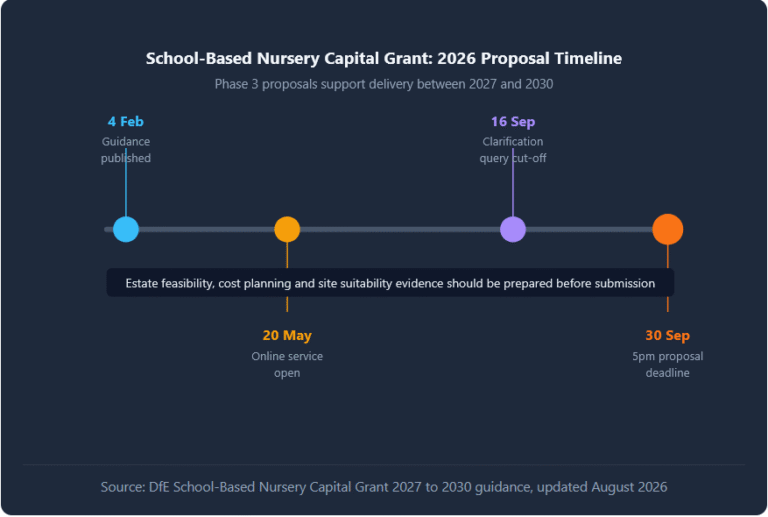
This timing creates a practical problem. A local authority may know which areas need more early years provisions, however it still needs site-specific information before a proposal is robust. That information may include plans, condition findings, access constraints, safeguarding requirements, cost estimates and confirmation that the space will remain suitable over the long term.
Schools that wait until the deadline is close may struggle to provide enough technical detail in their proposal. If a site needs a condition survey, feasibility sketch, M&E review or cost estimate, that work needs to happen before the proposal is finalised, rather than after the funding decision has been made.
The deadline should therefore be treated as the end of the preparation period, not the start. The strongest proposals will be those where demand evidence and estate evidence has been developed together.
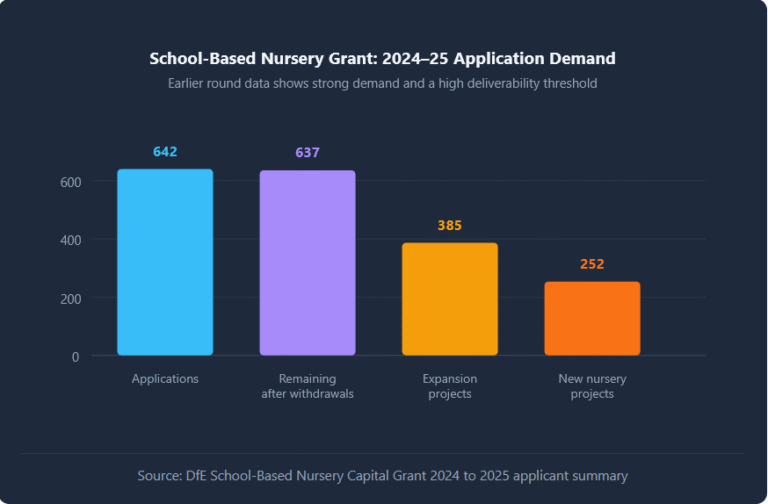
The earlier school-based nursery funding round showed a significant demand from schools seeking to expand provisions. The DfE data for the 2024 to 2025 capital grant records 642 applications, with 637 remaining after withdrawals, spread across 135 local authorities. The department reviewed applications to identify 300 high quality, deliverable nursery projects.
That data matters for phase 3 because it shows two things at once:
The DfE identified a smaller number of projects that were considered high quality and deliverable.
The estate case is part of that deliverability question. A school with strong local demand may still be a poor candidate if the only available space is poorly located, expensive to adapt, difficult to secure, remote from outdoor play or likely to compromise future school capacity.
The first question to ask is whether the school has space. The most important part of that question is whether that space is suitable, affordable and strategically sensible.
A good site assessment should consider the condition of the room or block, the available floor area, the relationship to reception classes, the availability of enclosed outdoor space, toilet and hygiene provisions, staff accommodation, access, safeguarding, kitchen or meal arrangements and any M&E works required to support nursery use.
DfE guidance recommends considering the following:
These are not just design preferences; they are core feasibility questions.
A technically weak proposal may underestimate cost, disruption or programme risk. A technically strong proposal will identify constraints early, explain how they will be managed and show why the selected site is the right estate option for the long term.
Nursery projects often look simple because they involve young children and relatively small spaces. In practice, the building requirements can be more demanding than expected.
Indoor space must meet the EYFS statutory framework. The DfE are establishing provision guidance that sets out base usable room areas of 3.5m² per child for children under 2 years old, 2.5m² for children 2 years of age and 2.3m² for children aged 3 to 5 years old. These figures exclude support spaces, storage, thoroughfares, staff areas, kitchens and toilets.
Toilets, nappy changing, direct classroom access, visibility, supervision, safe sleeping provision, low-level sinks, food preparation, storage and outdoor access also all needs careful thought. For children with SEND or additional toileting needs, discrete hygiene provisions may be required to maintain their dignity and safeguarding.
The estate risk is that these requirements are discovered after a preferred room has already been selected. This can force late stage redesign, cost increases or compromises that could have been avoided through early feasibility work.
Phase 3 proposals may involve more than one project, and local authorities can put forward more than one school-based nursery project through the online service. That makes comparison important.
The strongest approach is to use a consistent readiness framework. Each site should be assessed against local demand, suitability of space, condition, safeguarding, accessibility, outdoor play, transport impact, planning risk, M&E capacity, cost certainty and programme deliverability.
This prevents decision-making being driven only by enthusiasm or the apparent availability of a room. A site with surplus space may not be the best option if adaptation costs are high, outdoor access is poor or the proposal would compromise other strategic estate priorities.
For multi-academy trusts and local authorities, a consistent comparison also supports governance. It gives decision-makers a clear rationale for what projects should be prioritised, what ones should be developed further and what ones may need to wait.
Lancaster Maloney Martin can support schools, local authorities, academy trusts and responsible bodies with the estate evidence needed to make school-based nursery proposals more robust.
That support can include:
The objective is to establish whether a proposed nursery is not only desirable, but deliverable.
The key benefit is early clarity. Before a proposal is submitted, schools and local authorities should understand what works are required, what they are likely to cost, what constraints exist and how the project could be delivered without unnecessary disruption to the wider school environment.
That clarity is especially important where the proposed space needs reconfiguration, outdoor access is limited, safeguarding routes are complex, or the existing building condition is uncertain.
LMM’s building consultancy team works with property developers, public sector estates managers and multi-academy trusts across Manchester, Liverpool and London. If you’re planning a project in 2026 and need expert cost, programme and delivery guidance, speak to a consultant today.
It is phase 3 of the DfE school-based nursery programme. It invites local authorities to develop multi-year funding proposals to deliver new or expanded school-based nursery provision between 2027 and 2030. The grant can support projects in state-funded primary-phase schools, maintained nursery schools and Best Start Family Hub sites.
No. Individual schools cannot apply directly for the phase 3 grant. Schools interested in creating or expanding nursery provision should contact their local authority and prepare the site-level evidence needed to support a local authority proposal.
Local authorities must submit proposals through the online application service by 5pm on 30 September 2026. The DfE advises that clarification queries should be sent by 16 September 2026 to guarantee a response before the final submission date.
Useful evidence includes:
Cost planning helps local authorities and schools understand whether a proposal is realistic before it is submitted. Nursery projects can require more than decoration and furniture – toilets, hygiene facilities, drainage, access control, outdoor works, heating, ventilation, storage and safeguarding changes can all affect cost and deliverability.
The School-Based Nursery Capital Grant 2027 to 2030 is a significant opportunity for all local authorities and schools, however the strongest proposals will be those built on more than local demand. They will also need clear estate evidence.
A suitable nursery site must work for young children, staff, parents and carers to provide safeguarding, access, outdoor learning, hygiene and M&E systems while working alongside the wider school estate. The earlier these issues are tested, the easier it is to avoid late cost increases, design compromises and delivery risk.
For local authorities preparing phase 3 proposals before the 30 September 2026 deadline, the message is simple: identify demand, but test the buildings. A project that is credible on paper must also be workable on site.